
A hollow rotary platform and a direct drive rotary table can both position fixtures, rotate workpieces, and support automated inspection. Their practical differences involve transmission design, feedback, thermal behavior, and integration requirements. Choosing between them requires more than comparing nominal payload or encoder resolution.
One distinction is essential: a hollow rotary platform describes a structure with a central opening, while direct drive describes how the motor produces table motion. A direct drive table can also have a hollow center. These descriptions therefore overlap rather than define mutually exclusive product categories.
For a useful comparison, this article uses hollow rotary platform to mean a geared hollow rotary positioning unit. It compares that arrangement with a rotary table driven directly by a torque motor. The appropriate hollow rotary platform depends on the complete motion task and installation conditions.
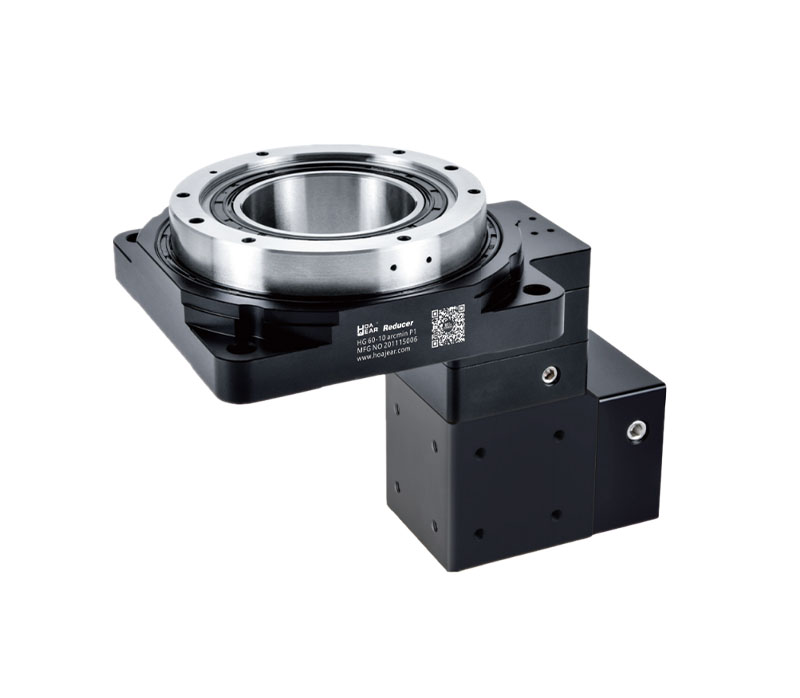
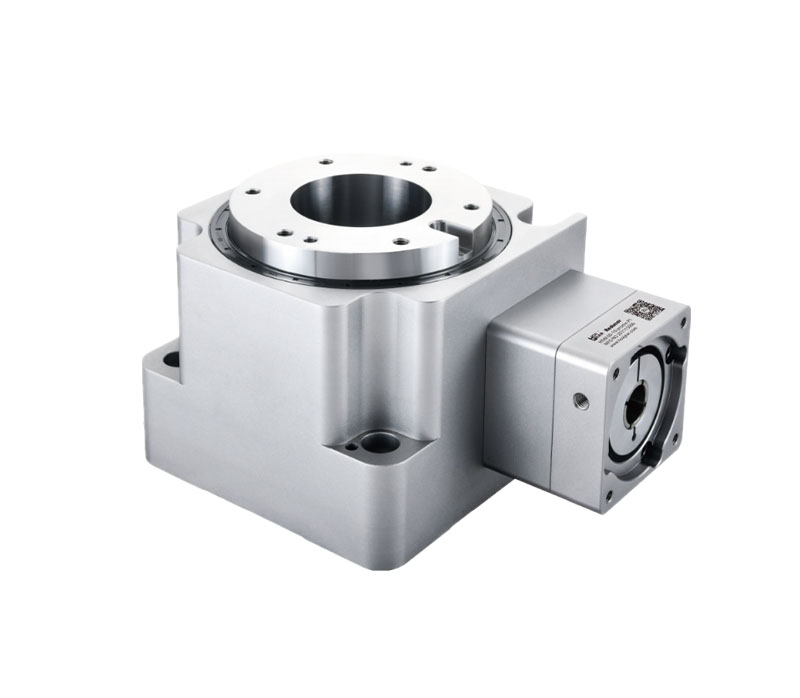
A geared hollow rotary platform combines an output flange, supporting bearings, a central opening, and a transmission connected to a motor. Depending on the model, the motor may be a stepper or servo, with feedback provided at the motor, output, or both.
The transmission reduces speed and increases available output torque, subject to efficiency and mechanical ratings. A hollow rotary platform can therefore provide useful torque from a comparatively compact motor. The benefit for a hollow rotary platform depends on ratio, speed, and duty cycle.
The central passage accommodates cables, hoses, optical paths, or tooling. A hollow rotary platform is consequently useful where equipment must interact with the rotating fixture through the center rather than around its perimeter.
A direct drive rotary table couples its motor rotor directly to the rotating assembly without a mechanical reduction stage. Bearings support the table, while an encoder supplies position feedback to the control system.
Compared with a geared hollow rotary platform, direct drive removes gear mesh backlash and transmission wear associated with that reduction stage. It also requires the motor to generate the necessary output torque directly, including acceleration torque and process disturbances.
This architecture can support smooth motion and responsive positioning when correctly designed and tuned. However, a hollow rotary platform comparison should still examine bearing behavior, structural stiffness, encoder installation, and thermal management. Removing gears does not eliminate every source of positioning error.
Accuracy measures closeness to a commanded position, while repeatability describes consistency when returning to a position under specified conditions. Encoder resolution describes measurement increments. These specifications are related, but none can substitute for the others.
A hollow rotary platform may repeat accurately from one approach direction while showing different results after reversal. Transmission errors, compliance, and feedback location affect that behavior. Some precision mechanisms substantially reduce backlash, so a geared design should not automatically be classified as inaccurate.
A direct drive table avoids gear transmission errors, but encoder eccentricity, calibration, bearing error motion, and temperature still matter. Compare the hollow rotary platform and direct drive table using equivalent test methods, loads, and approach directions.
Backlash usually refers to clearance between mating transmission elements. Lost motion is a broader measured effect that may include clearance, friction, and elastic deformation. A hollow rotary platform specification should identify which quantity is being reported.
Torsional stiffness determines how much the output twists under torque. Even a low-backlash hollow rotary platform can deflect when the process applies a changing load. Motor-side feedback may not directly detect every downstream displacement.
Direct drive removes gear clearance, but its resistance to disturbance also depends on servo behavior and mechanical stiffness. Evaluate both systems at the working fixture. The hollow rotary platform housing, adapters, mounting plate, and tooling can contribute significant movement beyond the transmission itself.
Output torque and payload capacity describe different requirements. A hollow rotary platform needs enough torque to accelerate the rotating inertia, overcome friction, and withstand process forces. The hollow rotary platform bearings must separately support axial loads, radial loads, and overturning moments.
For acceleration, torque follows rotational inertia multiplied by angular acceleration. Moving a fixture farther from the axis increases inertia, even if total mass stays unchanged. A hollow rotary platform carrying a compact load therefore behaves differently from one carrying a wide fixture.
Direct drive selection follows the same load calculations, but without torque multiplication through reduction. Compare continuous torque, peak duration, and allowable bearing loads independently. A hollow rotary platform with a high payload rating does not automatically deliver fast acceleration.
Maximum speed alone cannot predict production cycle time. The complete cycle includes acceleration, constant-speed travel where applicable, deceleration, settling, and process dwell. A hollow rotary platform may complete moderate indexing moves efficiently even when its maximum speed is relatively low.
Direct drive can offer strong dynamic performance because it avoids transmission compliance and backlash associated with gearing. Nevertheless, a large fixture, limited motor torque, or conservative control settings can restrict acceleration and settling.
Test the actual move profile rather than assuming one architecture is always faster. A hollow rotary platform should be evaluated using the intended indexing angle, payload inertia, positioning tolerance, and required dwell stability. Identical motor speeds do not establish comparable output performance.
The center opening of a hollow rotary platform can simplify routing for electrical cables, vacuum lines, pneumatic tubes, and illumination. However, an open center does not prevent cables from twisting as the table rotates.
For limited angular travel, a controlled cable loop may be appropriate. Repeated continuous rotation can require slip rings, rotary unions, or other suitable transfer devices. These components must match electrical, fluid, speed, and environmental requirements.
A direct drive table with a central bore offers similar routing possibilities. When comparing it with a hollow rotary platform, check the usable passage after installing connectors, adapters, and guarding. The nominal bore diameter of a hollow rotary platform may not equal the space available in the completed machine.
A hollow rotary platform generates losses through gears, bearings, seals, and lubricant movement. The motor also generates heat, some of which may reach the platform through its mounting interface. Running temperature depends on load, speed, ambient conditions, and heat dissipation.
A direct drive motor has no reduction-stage losses, but produces electrical and magnetic losses. Holding a stationary load against sustained torque can require continuous current and generate heat. Direct drive therefore does not automatically mean cooler operation.
Compare temperature rise and positioning drift over the actual duty cycle. A hollow rotary platform installed inside an enclosure may behave differently from the same unit tested on an exposed bench with a conductive mounting plate.
A hollow rotary platform may use a stepper system, closed-loop stepper system, or servo drive. The hollow rotary platform behavior depends on the selected motor, feedback arrangement, motion controller, and transmission. The presence of an encoder alone does not define the complete control architecture.
Reduction lowers the load inertia reflected to the motor approximately by the square of the ratio in an idealized model. This can help motor matching, although a hollow rotary platform also introduces transmission inertia, compliance, and losses.
Direct drive places the rotating load directly on the motor and requires appropriate servo tuning. Evaluate encoder compatibility, communication, safety functions, and commissioning support. Compare the complete hollow rotary platform package with the complete direct drive package rather than isolated mechanical components.
A geared hollow rotary platform requires attention to its specified lubrication method, seals, bearings, and mounting connections. A hollow rotary platform may be sealed and lubricated for their intended service life; others have defined servicing procedures. Do not assume every platform accepts routine grease replenishment.
A direct drive table eliminates gear maintenance associated with a reduction stage, but still includes bearings, feedback components, electrical connections, and possibly cooling equipment. It is not maintenance-free simply because gears are absent.
For either arrangement, monitor temperature, noise, vibration, and positioning behavior under consistent conditions. A hollow rotary platform that develops increased lost motion should be inspected for loose fixtures and couplings as well as internal wear before replacement is considered.
A hollow rotary platform can provide an economical solution for routine indexing when its motion specifications match the task. However, total cost includes the motor, drive, controller, adapters, cables, fixtures, commissioning, and any required transfer devices.
A direct drive table may justify additional system expense when smoother motion, frequent reversals, or tighter positioning requirements improve the process. Actual quotations depend on size, bearings, feedback, cooling, and configuration, so no universal price relationship applies.
Compare lifecycle cost using realistic assumptions. A hollow rotary platform that already meets the required cycle and accuracy may offer little benefit from replacement. Conversely, repeated adjustment or rejected parts can outweigh an initially lower purchase price.
| Selection factor | Geared hollow rotary platform | Direct drive rotary table |
|---|---|---|
| Transmission | Uses mechanical reduction | Motor drives the table directly |
| Center passage | Central opening is a defining feature | Available in hollow and solid configurations |
| Output torque | Influenced by ratio, efficiency, and mechanical limits | Produced directly by the motor |
| Reversal behavior | Depends on backlash, compliance, and feedback | No reduction-stage backlash; control behavior still matters |
| Thermal sources | Motor, transmission, bearings, and seals | Motor, bearings, and any auxiliary equipment |
| Maintenance | Check lubrication, bearings, connections, and transmission condition | Check bearings, feedback, connections, and cooling where fitted |
| Final selection | Verify complete application performance | Verify complete application performance |
Start with fixture geometry, total inertia, indexing angles, cycle time, and allowable error. Then specify mounting orientation, external forces, central passage requirements, environment, and available controls. A hollow rotary platform should be sized against those requirements before comparing purchase prices.
For repetitive assembly and moderate indexing, a hollow rotary platform may provide an effective balance of torque, packaging, and integration effort. Precision scanning or highly dynamic reversing tasks may favor direct drive when validated performance supports that choice.
Request documented ratings rather than relying on broad product labels. A hollow rotary platform inquiry should include drawings and a motion profile so torque, bearings, speed, and thermal limits can be checked together.
Mount the hollow rotary platform on a rigid, clean surface and verify the specified fastener engagement. Check fixture balance, cable forces, and clearances throughout the intended travel. Misaligned attachments or excessive tightening can affect performance regardless of the transmission architecture.
During commissioning, test positioning from both directions with the actual fixture and payload. Record settling time, temperature rise, repeatability, and process stability. Confirm behavior after warmup, rather than accepting a brief unloaded demonstration as proof of production capability.
Validate the hollow rotary platform over the complete operating cycle, including representative disturbances. Keep the results as acceptance criteria and future maintenance baselines. If testing a direct drive alternative, use the same conditions to support a fair comparison.
Neither architecture should be assumed to hold position safely after power loss. A hollow rotary platform may backdrive depending on its transmission, load, and friction. Specify any brake or mechanical restraint required by the machine. Validate the hollow rotary platform stopping and holding behavior separately from normal powered positioning.
Yes. Hollow describes the central opening, while direct drive describes the transmission architecture. A hollow rotary platform can therefore be directly driven. Always confirm whether the proposed unit uses gears or a torque motor.
No. It removes reduction-stage errors, but final accuracy also depends on feedback, calibration, bearings, structural behavior, and temperature. Compare measured performance for the complete installed system.
Either can work when correctly sized. Check inertia, acceleration, continuous torque, overturning moment, and bearing capacity. Fixture mass alone cannot establish which system is suitable.
No. A hollow rotary platform still needs suitable arrangements to prevent connected cables and hoses from twisting. Continuous rotation may require dedicated electrical or fluid transfer components.
QR Code


This website uses cookies to ensure you get the best experience on our website.


 Español
 Pусский
 Indonesia
 Tiếng Việt


 WhatsApp
 Phone
 E-mail
 Message
Comment
(0)